Connecting for Good

Bridging digital and socio-economic divides is a core pillar of our social purpose. At TELUS, we know technology can be a powerful equalizer, but only if everyone has access to it. Through our Connecting for Good® programs — including Health for Good™, Mobility for Good®, Internet for Good® and Tech for Good™ — we are leveraging our technology to ensure underserved citizens are connected to the people, information and opportunities that matter most in our increasingly digital society.

Mobility for Good expands to Manitoba
TELUS and Assembly of Manitoba Chiefs – First Nations Family Advocate Office (AMC-FNFAO) and Ka Ni Kanichihk announced the expansion of the Mobility for Good for Indigenous Women at Risk program in Manitoba, providing free devices with wireless plans to Indigenous women across the province. This partnership demonstrates a collaborative approach to disrupt gender-based violence while providing an important life line to First Nations, Métis and Inuit women.
“We know that First Nations women are disproportionately affected by violence, and access to technology can be a lifeline for those at risk,” said Grand Chief Kyra Wilson, Assembly of Manitoba Chiefs – First Nations Family Advocate Office. “This partnership with TELUS is a step towards addressing the challenges that Indigenous women face, providing critical tools for First Nations women in Manitoba to stay connected to their support networks, access resources and potentially save lives.”
While First Nations, Métis and Inuit women and girls comprise only four per cent of the total female population in Canada, they represent 24 per cent of female homicide victims. According to Native Women’s Association of Canada’s (NWAC), Manitoba has the third highest number of cases in Canada, accounting for 14 percent of all cases. This partnership contributes to the fight against gender-based violence and aims to support First Nations, Métis and Inuit women through access to free phones and wireless plans, helping them stay connected to support networks, resources and emergency services.
“The rate of violence against Indigenous women, girls and 2SLGBTQQIA+ is unacceptable. We have a responsibility to ensure that no matter where you live or your socio-economic status, you can always access critical health, safety and wellness services. Having a cellular device and reliable network is a vital lifeline,” said Jill Schnarr, Chief Social Innovation Officer, TELUS. “The expansion of Mobility for Good for Indigenous Women at Risk to Manitoba is part of our ongoing commitment to be a valued partner in advancing reconciliation and to support and promote Indigenous women’s health, safety and wellness. Leveraging our world-leading technology for good, we are proud to partner with Indigenous-led organizations that are helping deliver accessible services to prevent and end violence.”
Developed in partnership with Indigenous-led organizations, Mobility for Good for Indigenous Women at Risk provides free smartphones and talk, text and data plans to Indigenous women, girls or gender diverse people, serving as a critical lifeline to Indigenous-led services, wellness resources and their support networks. This work is further carried out to serve at-risk Indigenous women and girls through the AMC-FNFAO and Ka Ni Kanichihk .
Learn more about TELUS’ Mobility for Good for Indigenous Women at Risk program →
Building trust, one visit at a time
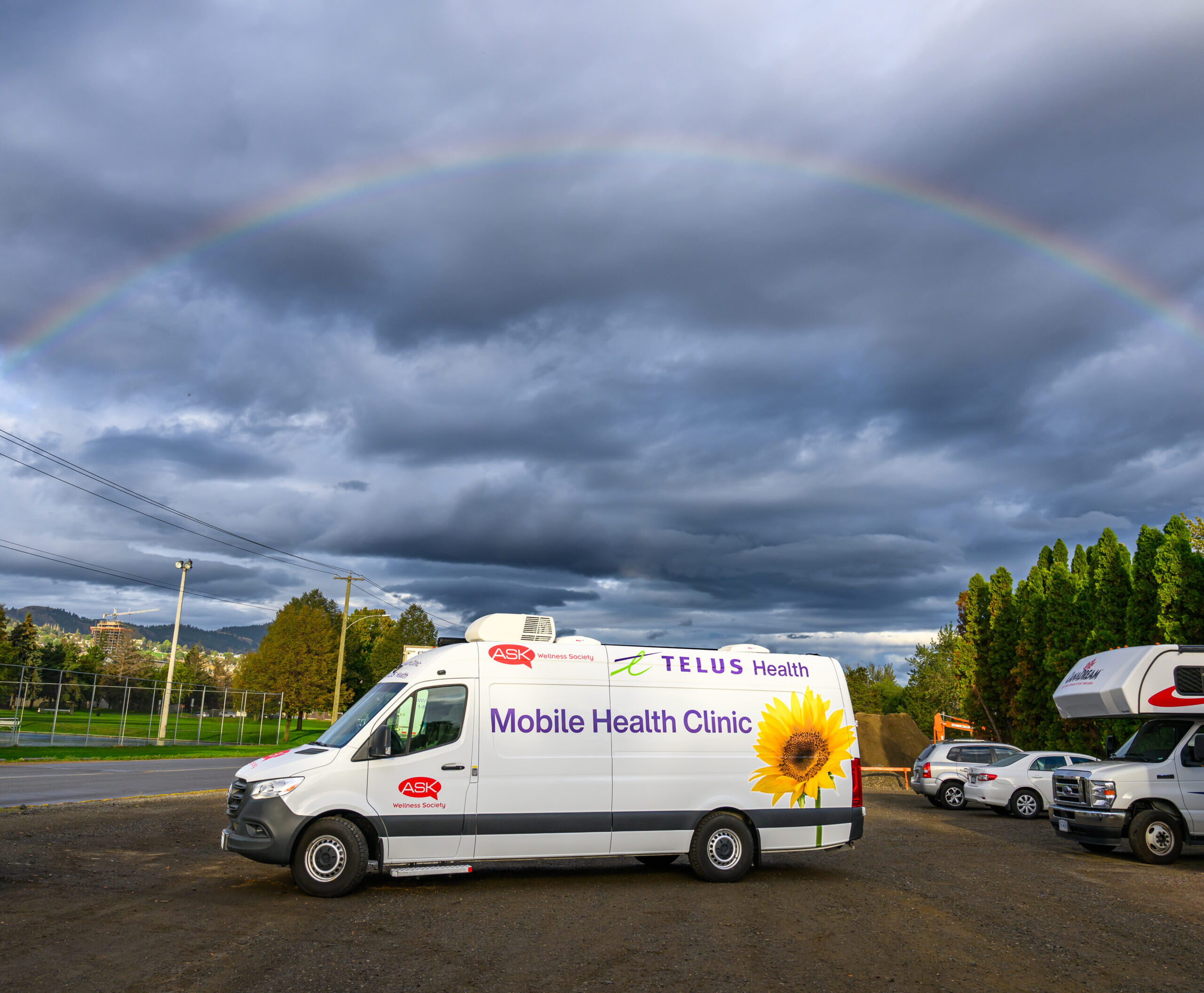
ASK Wellness Mobile Health Clinic
Many Canadians facing complex mental health or addiction issues experience barriers accessing healthcare. For Indigenous communities, these challenges can be further compounded by colonial trauma and systemic barriers. The TELUS Health for Good™ program connects thousands of underserved individuals to quality primary healthcare and social support services while respecting their dignity and cultural needs.
The ASK Wellness Mobile Health Clinic powered by TELUS Health launched in Kamloops in September 2024. This first-of-its-kind clinic serving B.C.’s Interior region has supported over 6,000 patient visits in just over a year. The 90-square-foot van serves as both medical facility and safe haven, operating at shelters, low-barrier housing programs, and local gathering areas, providing primary healthcare and connecting clients to mental health services, dental care, meals and more. Now entering its second year of service, 26% of patients supported by the clinic in 2025 were Indigenous community members.
“The community response has been incredibly positive, and our clients truly appreciate what we’re doing,” says Brock Robinson, ASK Wellness Society’s’ Outreach Worker. “We meet people without judgment, simply offering our support and compassion.” Working closely with Licensed Practical Nurse, Stacey George, they bring a trauma-informed and culturally safe approach to care. With a diverse range of training, including the Indigenous Cultural Safety, Humility and Anti-Racism Practice (BCCNM), Indigenous Awareness Training (BCIT), and the Indigenous Gender Diversity Certificate, they bring a deep understanding of the unique needs that exist within Indigenous communities.
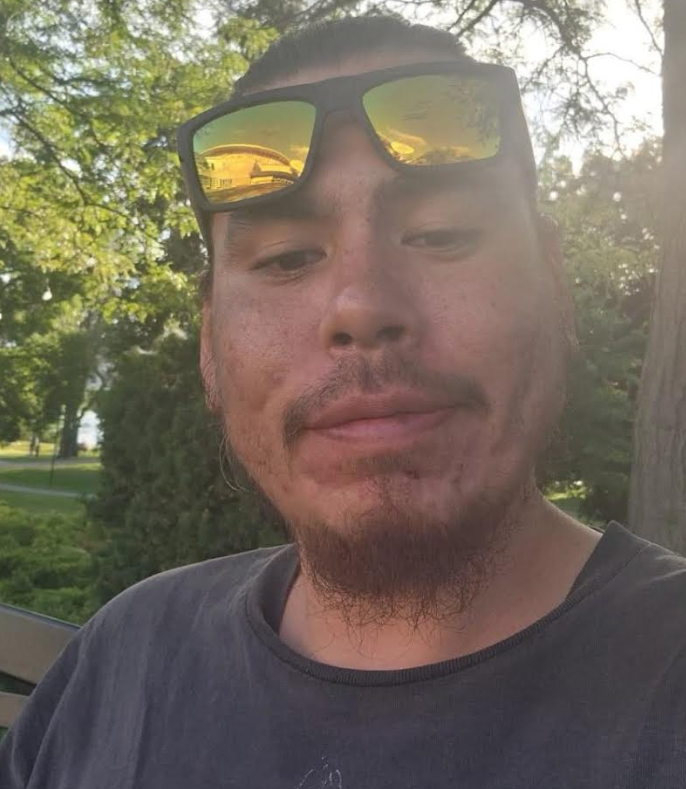
For Caleb, a Spax̌mn̓ (Spaxomin) First Nations member who visits the clinic on a regular basis, the impact has been life-changing. “Being homeless in Kamloops, the mobile clinic has been much help to me. They take great care of me when I need it most,” Caleb said. “They always come to find me, but the compassion shown by Brock and the rest of the staff makes me want to seek them out. They have built trust with those of us that find it hard to connect.”
The clinic addresses critical healthcare gaps while reducing pressure on emergency systems. “It gives us [Indigenous Persons] a lot out here living homeless, the healthcare given is so needed,” Caleb concluded. His words capture the program’s essence: ensuring equitable healthcare access by meeting Indigenous community members where they are, and offering support with dignity, compassion, and cultural respect.